
Leadership Development Speaker & Podcast Guest
Engage your Group
Practical conversations about leadership, strategy, and building healthier organizations.
Matt Musser, founder of Rooted Growth Strategies, speaks with business owners, executives, and leadership teams about the challenges of building and leading successful organizations. Drawing on his experience in business leadership and his work as a certified System & Soul coach, Matt offers practical guidance on developing leaders, aligning teams, improving operations, and creating healthy organizations.
Explore some of Matt’s recent speaking engagements below.
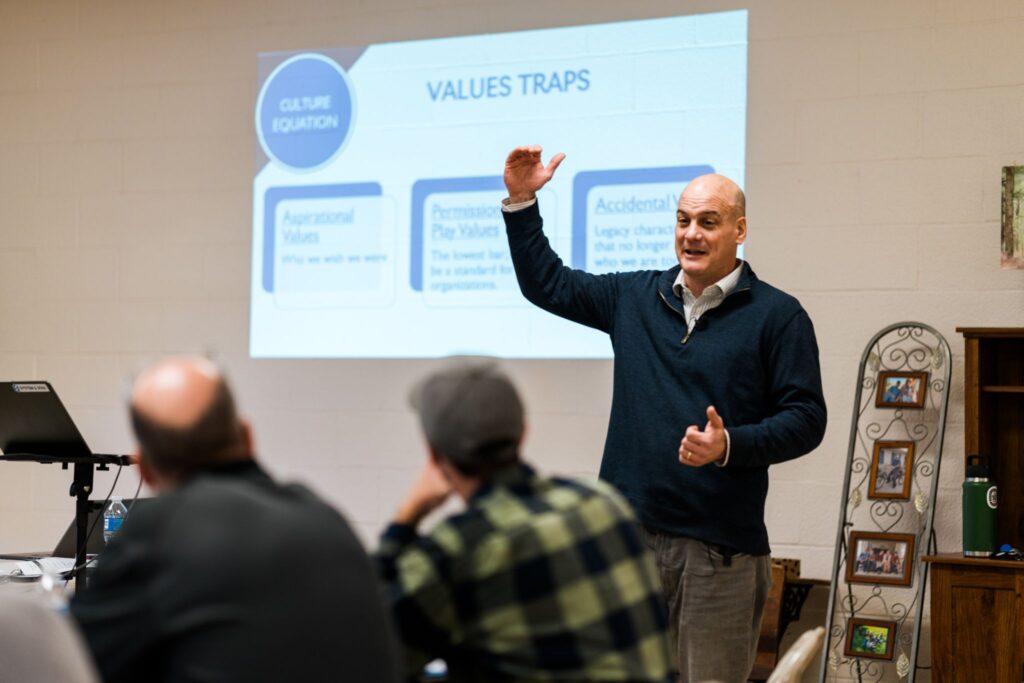
Speaking Log
MANTEC Continuous Improvement Peer Group | Sept. 17, 2026
Measure Your Business Without Losing Your Soul
Leverage the Power of KPIs Without Destroying Your Culture
The Challenge
Most continuous improvement professionals are already accustomed to measuring performance throughout their organizations. But are they measuring the right things? Matt joined MANTEC’s Continuous Improvement Peer Group, a group of professionals from manufacturing organizations focused on improving their operations, to discuss how businesses can make better use of their existing KPIs and scoreboards.
The Discussion
Building on his earlier presentation for the Lancaster Chamber’s Manufacturing Roundtable, Matt explored four types of performance measures: leading indicators, lagging indicators, diagnostic measures, and soul measures. He discussed how each serves a different purpose and how organizations can use them to better understand performance, identify problems, and support their people.
Matt also spent time discussing what he calls Leadership by Driving Your C.A.R. — Clarity, Autonomy, and Results. Drawing from his own leadership experience, he explained how difficult it can be to hold people accountable when leaders haven’t clearly defined expectations or given their teams the autonomy to accomplish their work. Matt acknowledged that he had struggled with this himself. Too often, when something started going wrong, he would step in and take ownership of the problem. When it came time to evaluate the results, it was difficult to hold someone else accountable for work he had taken over.
From the Room
Participants worked through an exercise to develop their own scoreboards, considering which measures would be most useful for their organizations. Because many already had KPI boards in place, the discussion focused on improving those measures rather than simply introducing new ones.
Matt also shared a memorable piece of leadership advice someone had given him: Give your leaders the freedom to shoot holes in the bottom of the boat until they start shooting below the waterline. The point was that leaders need to give their teams room to make mistakes and learn from them, rather than stepping in whenever something starts to go wrong.
Takeaways & Feedback
Following the presentation, a continuous improvement manager from a regional produce company contacted Matt to share that the discussion had prompted him to reconsider his organization’s scoreboards, particularly the opportunity to incorporate more leading measures.
MANTEC and Matt have also continued exploring opportunities to work together, including a subsequent joint presentation of System & Soul to a manufacturing company.
Lancaster SHRM | July 14, 2026
Meetings That Matter
Turn Motion into Momentum, Discussion into Decisions, Opinions into Commitment
The Challenge
Most organizations spend a tremendous amount of time in meetings, but how much are those meetings actually accomplishing? At the Lancaster SHRM chapter meeting, Matt challenged HR professionals to consider whether their team meetings were producing meaningful results or simply consuming valuable time and resources.
The Discussion
Matt introduced the System & Soul Weekly Sync, a structured meeting agenda designed to improve team connections, alignment, execution, and accountability. He explained how this approach keeps meetings focused, prevents unnecessary tangents, and drives conversations toward decisions and actions.
The Weekly Sync is often the first System & Soul practice Matt introduces to new clients because it tends to produce an immediate improvement in how their teams work together. When he asks clients what has made the biggest difference, they almost always point to their meetings. They’re more productive, decisions are being made, and the team is actually getting things done.
From the Room
During the workshop, participants took an inventory of their regular meetings, calculating the time spent attending, preparing, and traveling to meetings over the course of a year. For many, a single weekly meeting with eight participants represented as much as a quarter to a third of a full-time employee’s annual working hours.
The exercise helped participants recognize just how significant an investment their meetings represent—and why that investment should produce meaningful results.
Takeaways & Feedback
The presentation received overwhelmingly positive feedback. Attendees appreciated the practical worksheet and the opportunity to reconsider the return on investment of their meetings.
One participant commented that Matt’s presentation “really made you think about the meeting you hold and attend and the ROI,” while another described him as “a dynamic speaker” whose content was applicable to everyone in attendance.
Convene | Lancaster Bible College | March 19, 2026
Two Attributes of Exceptional Leaders
The Challenge
What makes someone an exceptional leader? Strategic thinking, effective communication, and the ability to execute are all important, but leadership has as much to do with who you are as it does with what you do. Matt explored this distinction with two groups of Convene business leaders during a presentation focused on the personal attributes that contribute most to leadership effectiveness.
The Discussion
Drawing from Tim Spiker’s The Only Leaders Worth Following, Matt introduced two foundational attributes: being inwardly sound and others focused. An inwardly sound leader is secure, self-aware, principled, purposeful, and attentive to their overall health. An others-focused leader demonstrates genuine care and concern for others.
Throughout the presentation, Matt connected these leadership principles with biblical teaching, drawing from Scripture to examine character, personal responsibility, and relationships.
Matt also discussed the Four Gates of Trust: respect, understanding, having another person’s best interests in mind, and competence. He challenged participants to consider how often leaders attempt to establish trust through their expertise without first demonstrating respect, understanding, and genuine concern for the people they lead.
From the Room
The presentation included an interactive exercise in which participants identified their leadership strengths and areas where they wanted to grow. Participants gathered with others who identified similar strengths, sharing how they had developed those attributes and what they had learned along the way. They then moved into groups focused on areas where they wanted to grow, giving participants an opportunity to learn from one another.
One participant spoke candidly about how journaling had helped him develop greater self-awareness. His willingness to share openly set the tone for the exercise, encouraging others to reflect on their own experiences and learn from one another.
Takeaways & Feedback
The presentation received very positive feedback from participants. In the post-event evaluations, attendees particularly appreciated Matt’s ability to connect with the group, communicate clearly, and encourage interaction.
One attendee described Matt as “Down to earth” and noted that he “Held attention. Created interaction.” Others specifically appreciated the integration of Scripture, the opportunity to interact with other participants, and Matt’s knowledge and authenticity.
Lancaster Chamber Manufacturing Roundtable | Feb. 3, 2026
Measure Your Business Without Losing Your Soul
Leverage the Power of KPIs Without Destroying Your Culture
The Challenge
Key performance indicators (KPIs) can be powerful tools for improving business performance, but they can also cause as much harm as good. Matt explored this challenge with manufacturing executives and business leaders at the Lancaster Chamber’s Manufacturing Roundtable, drawing heavily on his years of experience at Quaker Oats and Turkey Hill Dairy.
The Discussion
Matt discussed four types of performance measures: leading indicators, lagging indicators, diagnostic measures, and what he calls soul measures. While traditional KPIs help organizations measure performance and identify opportunities for improvement, soul measures focus on the human side of the business—employee engagement, satisfaction, and the things that contribute to a healthy working environment.
Matt also explained how to develop meaningful scoreboards, establish accountability, and avoid some of the unintended consequences of poorly designed performance measures. He encouraged leaders to begin with the mission of their organization and its individual roles, then develop measures that help people understand whether they’re accomplishing what they’re supposed to accomplish.
From the Room
To illustrate the risks, Matt shared several examples from his career.
In one, a customer service employee was considered among the company’s best performers because of the care and attention she gave customers. Yet her performance numbers were among the worst because the company measured the number of calls she completed rather than the quality of her service. Meanwhile, employees who rushed through calls and received customer complaints appeared to be performing well according to the same metric.
In another example from Quaker Oats, a new warehouse management system was accompanied by a compensation arrangement that rewarded employees based on the number of pallets moved. Initially, employees began selecting pallets based on convenience rather than following the appropriate inventory rotation procedures. Although that problem was addressed, the incentive system eventually made the warehouse increasingly expensive to operate. Despite the workers becoming highly efficient, the labor costs contributed to the plant’s eventual closure.
Takeaways & Feedback
These experiences reinforced one of Matt’s central points: Measures must serve the mission, not the other way around.
KPIs provide valuable information, but they don’t always tell the whole story. Matt encouraged participants to consider not only what they’re measuring, but how those measures influence behavior, decisions, and the people doing the work.
Northern Lancaster County Chamber — Chamber Chat | October 31, 2025
Build Your Business Without Losing Your Soul
Business Frameworks Panel Discussion
The Challenge
Many business owners start their companies hoping to build something successful, only to discover that the business has become increasingly dependent on them. At the Northern Lancaster County Chamber’s Chamber Chat, Matt joined System & Soul founder Benj Miller and Jeremy Blount of GCM Construction, a Rooted Growth Strategies client, for a discussion about business operating frameworks and how they can help organizations grow without losing the people and culture that make them successful.
The Discussion
Benj opened the event by sharing the experiences that led him to develop System & Soul. As his businesses grew, he found that the success he had worked so hard to achieve was actually limiting his freedom. Every important decision came back to him, and others weren’t empowered to move forward without his involvement.
After finding success with the Entrepreneurial Operating System (EOS), Benj eventually recognized the need for a framework that addressed not only business operations but also organizational culture and the well-being of employees. That realization contributed to the development of System & Soul.
The conversation then moved into a panel discussion about implementing business frameworks, developing leadership teams, and maintaining organizational health.
Matt spoke about one of the most common barriers he sees among business owners: the difficulty of stepping away from daily operations long enough to work on the business rather than just in it. Too often, leaders become caught in the tyranny of the urgent, spending their days reacting to immediate problems rather than planning for the future.
From the Room
During the panel discussion, Matt explained how System & Soul helps organizations move away from depending on one person to make every important decision. By involving the leadership team in developing a shared vision, business owners can give others the clarity and ownership they need to make decisions that move the organization toward its goals.
Drawing from his experiences with clients, Matt noted that improvements in team meetings are often among the first noticeable benefits of implementing the framework. Meetings become more productive, decisions get made, and teams begin following through on their commitments.
Matt also discussed the importance of balancing the system with the soul. While operational measures and accountability are valuable, leaders must be careful not to create an environment where employees feel they’re simply numbers on a scoreboard.
Takeaways & Feedback
The panel brought together three perspectives on the System & Soul framework: Benj’s experience developing it, Matt’s work helping organizations implement it, and Jeremy’s firsthand experience using it in his business.
The discussion addressed practical questions about leadership, accountability, organizational culture, and how business owners can develop organizations that function effectively without depending on them for every decision.
Southern Lancaster County Chamber Professional Development Conference | October 22, 2025
Step Back to Move Forward
Planning with Clarity and Intent
The Challenge
Business leaders are often good at getting things done, but are they getting the right things done? At the Southern Lancaster County Chamber’s Professional Development Conference, Matt led a workshop focused on the importance of stepping away from daily operations to develop a clear vision and an intentional plan for moving the business forward.
The Discussion
Matt explained that while a one-person business can often operate effectively without much formal planning, growing organizations need a strategy to coordinate the activities of everyone involved. Even a sound strategy, however, isn’t enough without a clear vision of where the organization is going.
He introduced three connected elements of effective organizational leadership: magnetic vision, focused strategy, and effective execution. A magnetic vision gives people a shared understanding of what they’re trying to achieve. A focused strategy establishes how they’ll get there, and effective execution moves the organization toward that vision.
Matt also discussed the problems that arise when one or more of these elements is missing. Without a clear vision, organizations can become consumed by competing initiatives, scattered decisions, and changing priorities. Without a sound strategy, leaders may find themselves constantly making decisions for their teams, leading to frustration and burnout.
From the Room
As part of the workshop, Matt guided participants through the Hedgehog Concept, a vision-casting exercise based on three questions: What are you most passionate about? What can you be the best at? And what drives your economic engine?
By identifying where these three areas intersect, business leaders can begin recognizing opportunities that fit their organization’s strengths, purpose, and financial realities.
The workshop was presented to three groups of conference attendees, giving participants an opportunity to consider these questions in the context of their own businesses.
Takeaways & Feedback
Matt recalled that participants could readily relate to the challenges he described, particularly the problems that arise when organizations lack a clear strategy or vision.
For some, that meant competing initiatives and scattered decisions. For others, it meant an overburdened leader who remained responsible for everything.
The workshop gave participants an opportunity to step away from the daily demands of their businesses, consider where their organizations were headed, and think more intentionally about how to get there.
Invite Matt To Speak at Your Next Event or Podcast
Matt speaks on leadership development, strategic planning, business operating frameworks, and organizational health. His presentations combine firsthand business experience with practical tools that participants can bring back to their own organizations.